India suffers from one of the starkest geographic distributions of medical specialists in the world: while over 65% of the nation’s population resides in rural blocks and semi-urban towns, nearly 75% of qualified specialist doctors—cardiologists, endocrinologists, neurologists, nephrologists, oncologists, and pediatricians—practice in metropolitan and Tier-1 urban centers. For a citizen living in a rural tehsil in Uttar Pradesh, Bihar, Madhya Pradesh, Odisha, or Rajasthan, consulting a specialist for uncontrolled hypertension or a pediatric fever historically meant sacrificing a full day’s daily wage and traveling 60 to 150 kilometers to a district or state capital.
Over the past five years, India has demonstrated to the world that digital public infrastructure can bridge this specialist gap at population scale. Led by the Ministry of Health and Family Welfare’s eSanjeevani national telemedicine service—which has crossed hundreds of millions of teleconsultations—and the National Health Authority’s Unified Health Interface UHI teleconsultation protocol, virtual care in India has evolved far beyond standalone consumer video-calling apps. Today, both state health missions and private multi-specialty hospital chains are deploying the telemedicine hub and spoke model India to extend specialist care deep into underserved districts while building sustainable referral ecosystems.
Why Assisted “Doctor-to-Doctor” Hub-and-Spoke Outperforms Pure Direct-to-Consumer Video Calls
During the COVID-19 pandemic, dozens of direct-to-consumer (B2C) teleconsultation apps launched in India, assuming rural and semi-urban patients would independently book smartphone video calls with urban doctors. While B2C teleconsultations work well for digitally savvy urban professionals seeking quick follow-ups, pure unassisted video calls hit three clinical walls in Bharat:
- Absence of Objective Vitals and Physical Examination: A cardiologist or internist on a smartphone screen cannot auscultate lung sounds, measure blood pressure, check capillary blood glucose, or inspect a 12-lead ECG if the patient is sitting alone at home without diagnostic equipment.
- Digital Literacy and Bandwidth Barriers: Elderly patients and rural citizens often struggle with app downloads, camera lighting, and describing complex medication histories without clinical mediation.
- Disconnected Downstream Fulfilment: Even if an urban doctor sends a PDF prescription to a rural patient’s phone, the patient still needs local blood tests, verified generic medicines, and a structured pathway if inpatient admission is required.
The telemedicine hub and spoke model India—pioneered at national scale by eSanjeevani AB-HWC (Ayushman Arogya Mandir) and replicated by leading private hospital chains—solves all three problems through Assisted Telemedicine:
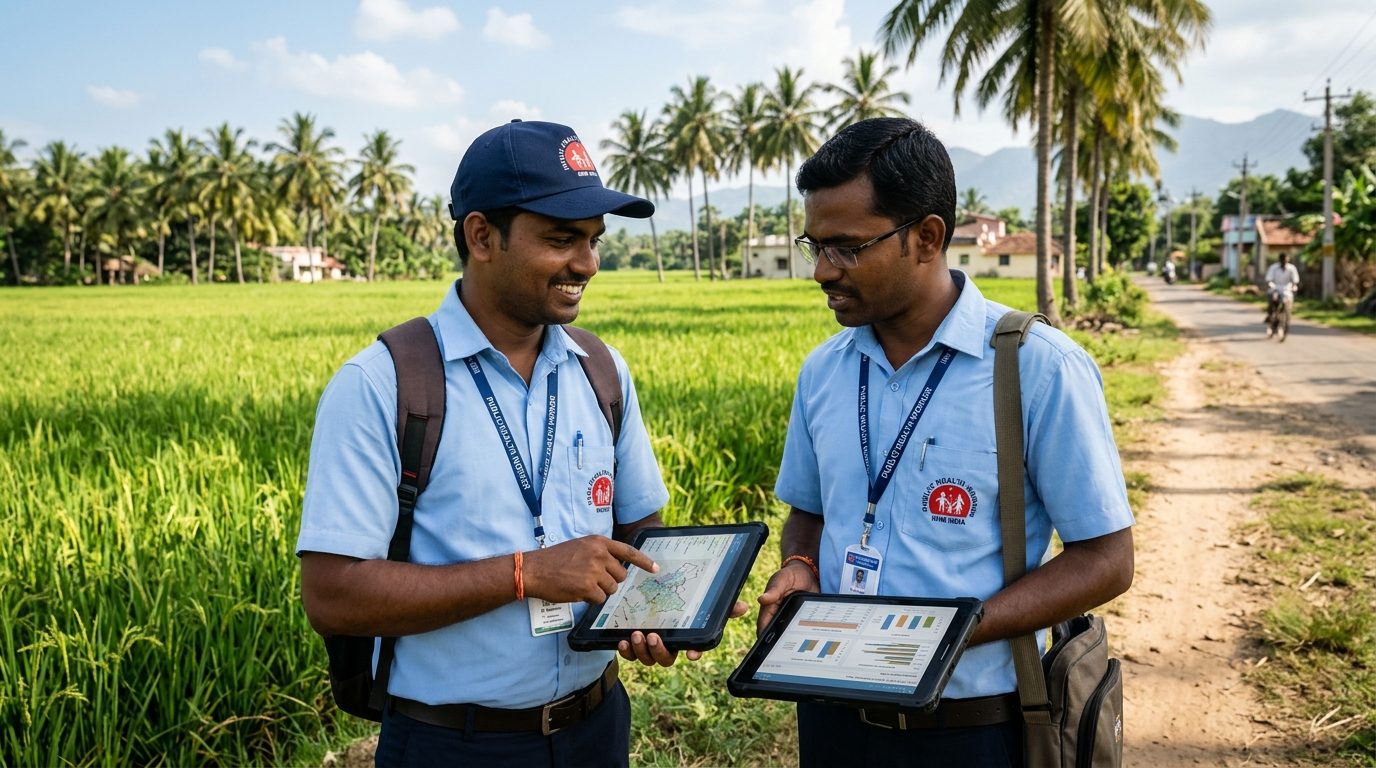
- The Spoke (Ayushman Arogya Mandir, PHC, Vision Center, or Partner Clinic): The patient walks into a local spoke facility near their village or neighborhood. A trained Community Health Officer (CHO), nurse, or general medical officer captures vital signs (
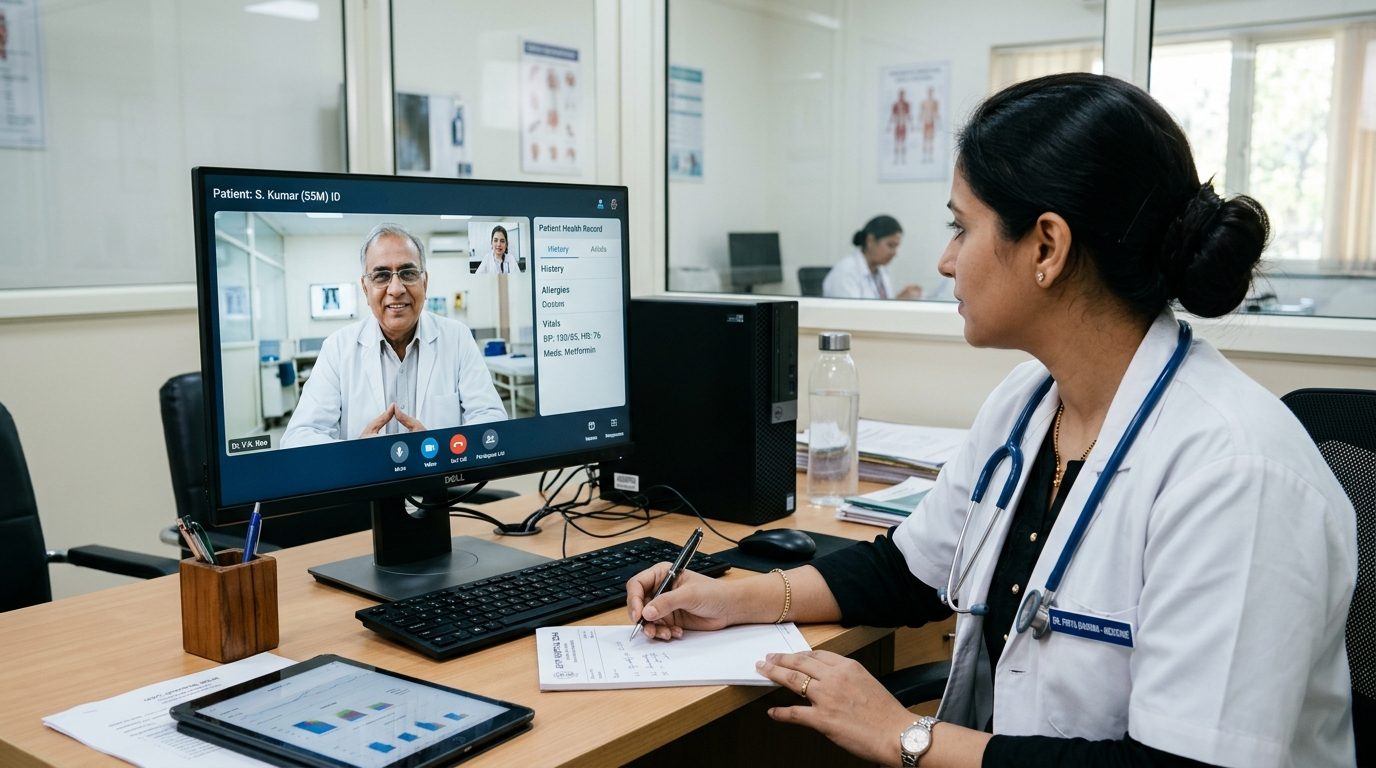
BP,SpO2,Temp,Pulse), performs point-of-care rapid tests (hemoglobin, blood sugar, malaria/dengue, digital ECG, or fundus camera imaging), and uploads the structured clinical intake into the EMR. - The Hub (Tertiary Hospital Specialist Command Center): The spoke clinician initiates a live, context-rich video consultation with a specialist at the central hub. Because the specialist views verified vitals, LIMS point-of-care results, and the patient’s ABHA longitudinal chart before the video call even connects, a high-precision specialist consultation completes in under four minutes.
Complying with the Telemedicine Practice Guidelines (NMC India)
Every teleconsultation platform operating in India must enforce statutory compliance with the Telemedicine Practice Guidelines NMC India (issued by the Board of Governors in supersession of the Medical Council of India / National Medical Commission in partnership with NITI Aayog). Rather than leaving compliance to individual doctor memory, an enterprise telemedicine module inside your HIS must hard-code regulatory guardrails directly into the prescribing workflow:
- Mandatory Clinician & Patient Identification: Every teleconsultation screen and generated e-prescription must display the Registered Medical Practitioner’s (RMP) full name, qualification, State Medical Council registration number, and ABDM HPR identifier, alongside verified patient demographics and ABHA ID.
- Explicit Consent Recording: Whether the consultation is patient-initiated or health-worker-initiated at a spoke clinic, the platform must log an explicit, timestamped consent artefact in the EHR.
- Automated Drug List Enforcement (List O, List A, List B, and Prohibited List): The NMC guidelines strictly classify which medications may be prescribed via telemedicine depending on consultation mode and context:
- List O: Safe over-the-counter and essential primary care medicines (paracetamol, ORS, antacids, vitamins) permissible across any teleconsultation mode.
- List A: First-line medications (such as certain antihypertensives, antidiabetics, inhalers, and topical antifungals/antibiotics) that may be prescribed during a first consultation only if conducted via live video, and for refill/follow-up consultations.
- List B: Add-on medications prescribed during a follow-up teleconsultation for a pre-existing chronic condition.
- Prohibited Category: Schedule X drugs, narcotics, and psychotropic substances regulated under the NDPS Act—which the HIS e-prescribing engine must automatically block from being signed during a virtual encounter.

List O, List A, List B) and showing automatic red-flag blocking of Prohibited Schedule X / NDPS medications.How the Unified Health Interface (UHI) Opens Up Virtual Care Discovery
Just as UPI decoupled payment apps from banks, the National Health Authority’s Unified Health Interface UHI teleconsultation network decouples patient-facing discovery apps (End User Applications — EUAs) from hospital provider systems (Health Service Provider Applications — HSPAs).
When a hospital’s HIS is enabled as a UHI HSPA node, a patient searching for a “Pediatric Neurologist teleconsultation” or “Diabetologist follow-up” on any UHI-connected PHR app can discover real-time slot availability at your hospital, book and pay via UPI, conduct the video consultation, and receive an NRCeS-compliant PrescriptionRecord FHIR bundle directly into their ABHA health locker—without the hospital paying 30% aggregator commissions to private listing portals.
Extending to Critical Care: Rural PHC and District Hospital Tele-ICU Networks
Beyond outpatient consultations, hub-and-spoke virtual care is transforming inpatient survival in district and sub-divisional hospitals through rural PHC to specialist tele-ICU connectivity (frequently modeled on state initiatives like Karnataka’s 10-Bed ICU project and NHM Tele-ICU grids). By streaming continuous multipara bedside monitor telemetry, ventilator waveforms, ABG lab values, and PTZ camera feeds from 10-bed district ICUs to a 24×7 command center staffed by senior intensivists at a medical college or corporate tertiary hub, critical care protocols are guided in real time—reducing unnecessary emergency ambulance transfers and saving lives during the golden hour.

Powering Your Virtual Care & Hub-and-Spoke Network with OneHealthGrid
Whether you are a multi-specialty hospital chain launching 50 regional spoke clinics, a CSR healthcare foundation serving rural blocks, or a state public health agency scaling assisted telemedicine, OneHealthGrid embeds low-bandwidth WebRTC video, NMC-compliant e-prescribing, peripheral IoMT device capture, and native ABDM/UHI interoperability into one unified platform.
Accelerate Your Healthcare Digital Transformation with OneHealthGrid
Looking to implement enterprise-grade interoperability, clinical intelligence, and national digital health compliance across your hospital network? Explore our OneHealthGrid Telemedicine & Hub-and-Spoke Virtual Care Platform or schedule a personalized architecture consultation with our healthcare engineering specialists.
National Standards & Regulatory References: Ayushman Bharat Digital Mission (ABDM) • National Health Authority (NHA) • NRCeS HL7 FHIR R4 Implementation Guides