Replacing or upgrading the core Hospital Information System (HIS) in a live, 24×7 multi-specialty hospital is often compared to replacing the engines on an aircraft while it is flying at 35,000 feet. Unlike a corporate office or a retail store that can close over a long weekend to install new software, an acute-care hospital never sleeps: emergency trauma bays admit patients at 3:00 AM, intensive care nurses titrate infusions every hour, operation theatres run emergency C-sections, and inpatient billing counters process discharges around the clock.
Because the stakes are so high, fear of cutover disruption is the single biggest reason hospital boards delay essential digital modernization. Yet cutover chaos is never an inevitable byproduct of new technology—it is the result of undisciplined migration engineering and rushed change management. Executing a zero-downtime hospital HIS implementation relies on a battle-tested, phase-gated engineering methodology covering master data standardization, Master Patient Index MPI deduplication, dress-rehearsal parallel runs, and structured floor hypercare.
Why “Lift-and-Shift” Legacy Data Migrations Fail
When migrating off a 10- or 15-year-old hospital software database, the most dangerous temptation is performing a raw “lift-and-shift” copy of legacy tables into the new platform. Over a decade of unvalidated data entry, legacy hospital databases accumulate severe structural rot:
- Duplicate and Polluted Patient Records: The same patient appears under four different UHIDs due to spelling variations (
"Mohammed" vs. "Mohd","Smt. Kavita Sharma" vs. "Kavita S."), family members sharing a single mobile phone number, or temporary emergency registrations that were never merged. - Bloated and Contradictory Charge Masters: Thousands of obsolete tariff items, duplicate investigation names with conflicting prices, and inactive pharmacy SKUs lacking standardized generic drug codes or HSN/GST mappings.
- Unstructured Clinical Blobs: Historical discharge summaries and lab reports stored as unindexed Rich Text (RTF), local file-share paths, or proprietary binary blobs.
A disciplined legacy EMR data migration strategy treats migration not as a database copy, but as an Extract, Cleanse, Standardize, Deduplicate, and Validate (ECSDV) engineering pipeline.
Mastering Master Patient Index (MPI) Deduplication Without Losing History
During Master Patient Index MPI deduplication, safety is paramount: merging two distinct patients who happen to share a common name and birth year is a critical clinical hazard (“overlay error”), whereas failing to link a returning patient’s historical records leaves clinicians blind to prior allergies and surgeries.
To achieve zero-overlay accuracy, enterprise migration teams use a Three-Tier Matching Protocol:
- Tier A — Deterministic Auto-Link: Records sharing a verified 14-digit ABHA number, government ID, or exact
(Normalized Full Name + Date of Birth + Gender + Primary Mobile)tuple are linked automatically, with legacy secondary UHIDs preserved as searchable alias pointers so old printed patient cards still scan at reception. - Tier B — Probabilistic / Steward Review Queue: Records where two of three attributes match (for example, identical mobile number and surname, which in India often represents a spouse, parent, or child within the same household) are flagged as Household / Family Linked Accounts rather than blindly merged into one person.
- Tier C — Active Inpatients (“In-House Census”) Freeze & Cutover: For the 150 to 500 patients physically occupying inpatient beds on the night of cutover, a dedicated In-House Census Migration Protocol transfers active admission demographics, current bed/ward assignments, advance deposit balances, and running interim bills with 100% manual + automated dual-signoff.
The Clinical Super-User Training Framework and Role-Based Simulation
Classroom slide presentations rarely prepare a ward nurse or billing executive for the pressure of a Monday morning OPD rush. A high-adoption clinical super-user training framework replaces passive lectures with hands-on, role-specific simulation:
- Identify Departmental Champions (1:8 Ratio): Select tech-savvy nurses, resident doctors, pharmacists, lab technicians, and TPA executives from within the hospital’s own staff three weeks prior to go-live and train them as certified Super-Users.
- Day-in-the-Life (DITL) Dress Rehearsals: Before touching production, run two full-scale Mock Cutover & Dress Rehearsal simulations in a sandbox environment populated with the hospital’s actual migrated master data, testing 50+ real-world edge cases: emergency unknown trauma admission, blood bank cross-match, OT package upgrade, LIMS critical value alert, TPA pre-auth query, and midnight bed census reconciliation.
Parallel Run, The 72-Hour Go-Live War Room, and Hypercare Governance
The transition from legacy software to the new HIS is governed by strict phase-gate sign-offs signed jointly by the Medical Director, Nursing Superintendent, CFO, and CIO. During hospital parallel run and hypercare governance:
- The Off-Peak Cutover Window (Saturday 11:00 PM – Sunday 04:00 AM): Cutover is scheduled during the lowest outpatient activity window of the week. At 11:00 PM Saturday, legacy outpatient billing is frozen, final EOD trial balances are extracted, active inpatient balances and pharmacy ward stocks are migrated and verified, and by 04:00 AM Sunday, all workstations switch to the new live production environment.
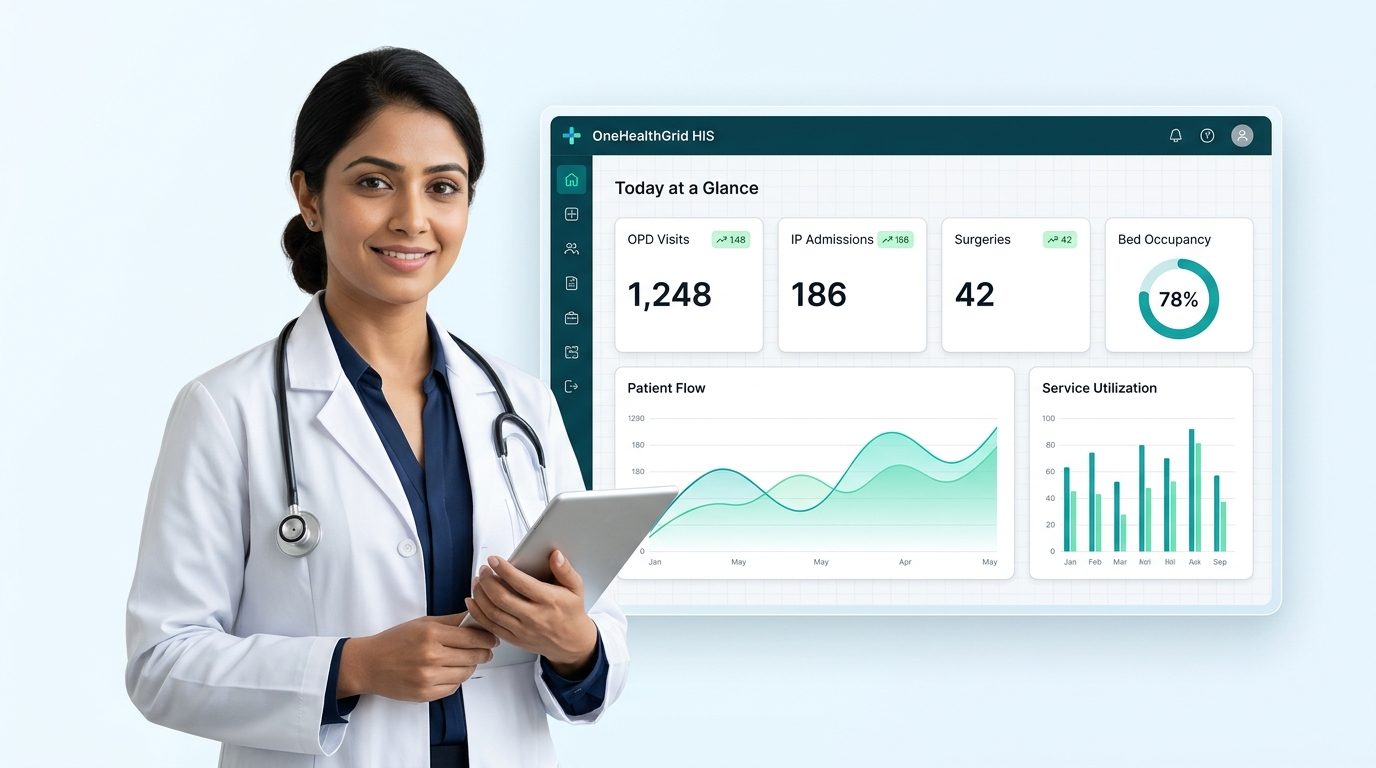
- 24×7 Floor-by-Floor War Room Coverage: For the first 72 hours (especially Monday morning 7:30 AM OPD opening), every reception desk, nursing station, pharmacy counter, and diagnostic lab has a floor-walking implementation specialist and certified Super-User stationed physically alongside staff to resolve questions in under 60 seconds.
- Documented Rollback & Contingency Protocols: Every critical counter maintains pre-configured offline/contingency workflows and deterministic rollback checkpoints until 7 consecutive days of EOD financial and clinical reconciliation sign-offs are completed.
Partnering with OneHealthGrid for Predictable, Zero-Disruption Transformation
A hospital HIS implementation should be an inspiring milestone for your clinicians and staff—not a source of operational anxiety. OneHealthGrid’s Consulting & Implementation practice combines automated EMPI migration pipelines, pre-built analyzer and ERP connectors, and dedicated on-site clinical transformation specialists to deliver on-time, zero-downtime hospital rollouts across India.
Accelerate Your Healthcare Digital Transformation with OneHealthGrid
Looking to implement enterprise-grade interoperability, clinical intelligence, and national digital health compliance across your hospital network? Explore our OneHealthGrid Zero-Downtime HIS Implementation & Migration Services or schedule a personalized architecture consultation with our healthcare engineering specialists.
National Standards & Regulatory References: Ayushman Bharat Digital Mission (ABDM) • National Health Authority (NHA) • NRCeS HL7 FHIR R4 Implementation Guides