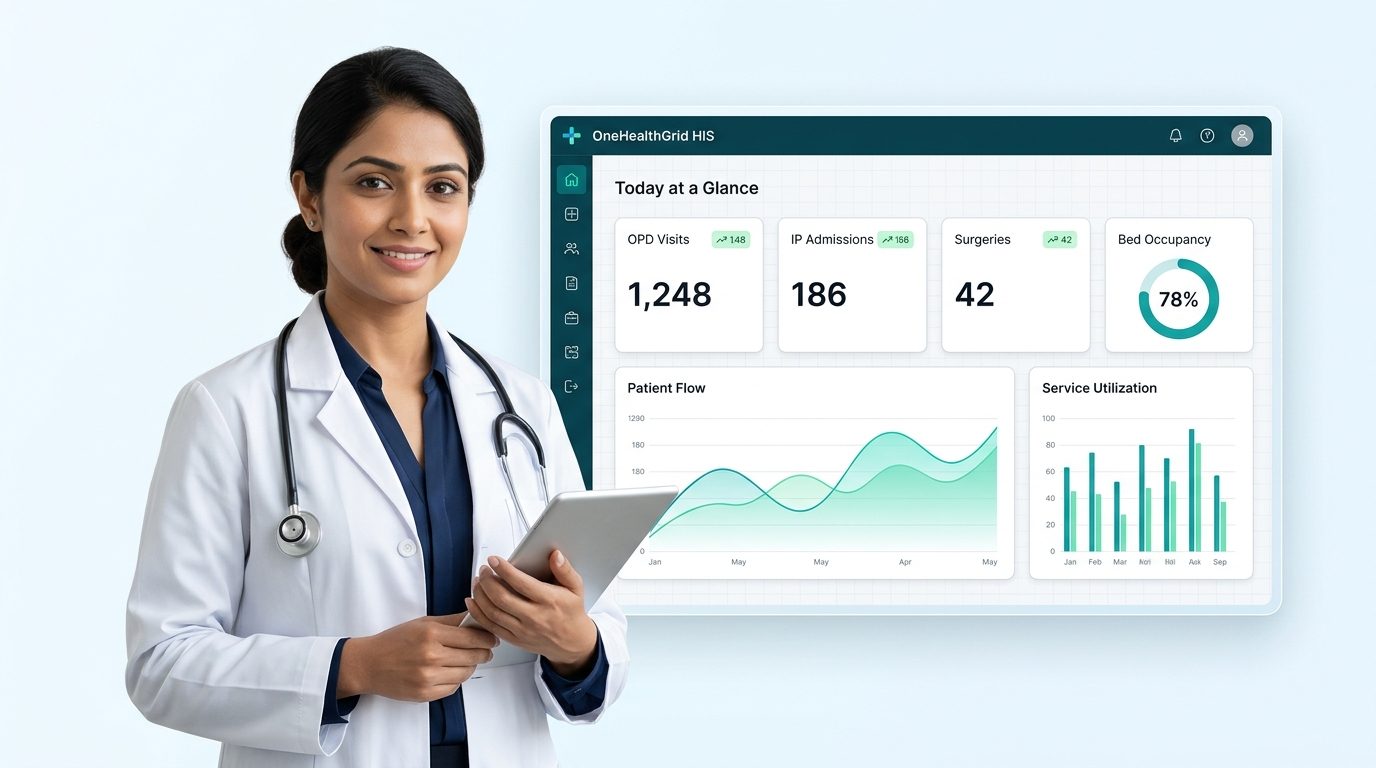
Across India’s healthcare sector, a quiet infrastructure crisis is unfolding inside established 100- to 1,000-bed hospitals. Over the past two decades, most hospitals accumulated technology piecemeal: an on-premise billing and registration package written in the early 2000s, a standalone Laboratory Information Management System (LIMS) procured for the pathology department, a separate PACS server in radiology, a retail pharmacy inventory tool, and paper-based inpatient case sheets held together in physical plastic folders at the nursing station.
While this patchwork kept basic cash counters running in an era of walk-in cash medicine, it is structurally incapable of supporting today’s connected healthcare mandates—including real-time Ayushman Bharat Digital Mission (ABDM) interoperability, National Health Claims Exchange (NHCX) FHIR claim automation, multi-center clinical analytics, and NABH digital health accreditation readiness. Executing a disciplined Hospital Information System modernization India roadmap allows hospital boards and CIOs to retire brittle legacy silos and transition to a unified, cloud-ready clinical and operational core without disrupting 24×7 patient care.
The Hidden Cost of Running Legacy Client-Server HIS Platforms
Many hospital CFOs hesitate to replace a 15-year-old legacy HIS because the software license appears “fully depreciated.” In reality, legacy client-server hospital software imposes massive, compounding operational taxes every single day:
- Fragmented Patient Identities: When OPD registration, diagnostic labs, and emergency admissions maintain separate patient tables—or allow receptionists to register returning patients without strict deduplication—a single citizen ends up with three or four disconnected UHIDs. Clinicians cannot see historical drug allergies, prior surgical implants, or baseline renal function tests across visits.
- Revenue Leakage Between Ward and Billing Counter: In paper-assisted inpatient wards, nursing consumables, bedside procedures (nebulization, catheterization, wound dressings), and emergency stat medications are jotted in ward registers and sent manually to the billing desk at discharge. Industry audits consistently show hospitals lose 4% to 9% of legitimate billable inpatient consumables to uncaptured or delayed manual entries.
- Zero Native Interoperability: Legacy databases built around proprietary schemas cannot emit HL7 FHIR R4 bundles, validate SNOMED CT / LOINC terminologies, or expose OAuth 2.0 secured APIs without expensive, fragile third-party middleware wrappers.
Core Architectural Pillars of a Modern Cloud-Native HIS
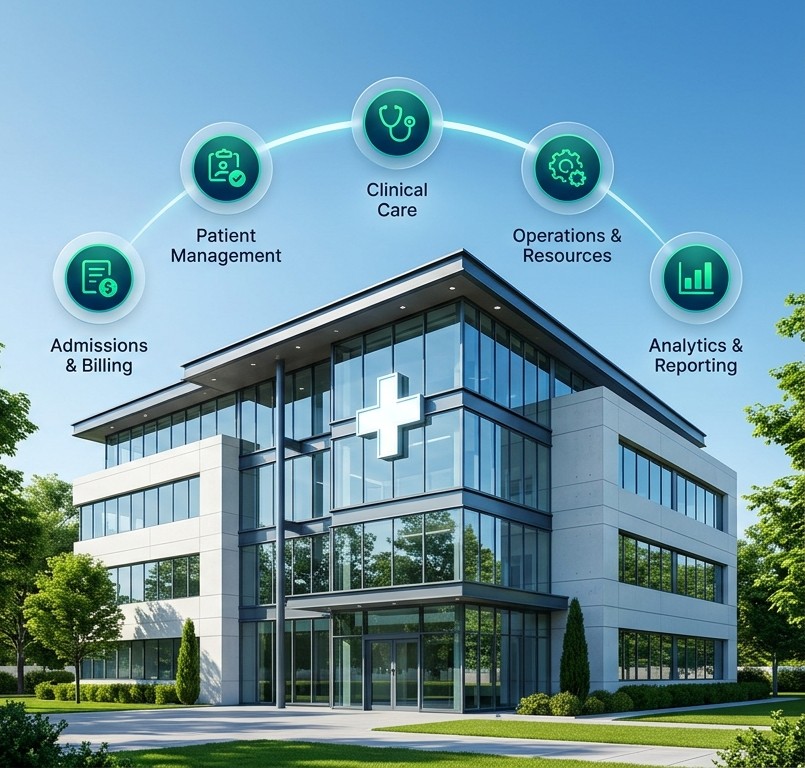
When evaluating next-generation platforms for Hospital Information System modernization India, hospital technology committees should insist on four foundational architectural pillars:
1. Enterprise Master Patient Index (EMPI) Linked with 14-Digit ABHA
Every clinical, diagnostic, and financial transaction across every hospital branch must resolve to a single, enterprise-wide unified Master Patient Index MPI India. Modern EMPI engines combine deterministic matching (14-digit ABHA number, Aadhaar-verified mobile, government ID) with phonetic and demographic matching to prevent duplicate UHID creation at registration counters, emergency bays, and mobile patient portal bookings.
2. Closed-Loop Computerized Physician Order Entry (CPOE) and eMAR
In a modernized inpatient ward, paper medication kardexes and handwritten investigation slips are replaced by paperless inpatient eMAR and CPOE:
- CPOE at the Bedside: Resident and consultant doctors enter medication orders, diagnostic panels, diet instructions, and nursing care plans directly on ward tablets or workstations using pre-configured specialty order sets (e.g., Post-PTCA ICU Order Set or Laparoscopic Cholecystectomy Pathway).
- Clinical Pharmacist Verification: Inpatient pharmacy receives the electronic order instantly, verifies dosage, renal function adjustments, and drug-drug interactions, and dispatches unit-dose barcoded medications via pneumatic tube or ward trolley.
- Bedside Barcode eMAR: Before administering any high-alert medication, the ward nurse scans the patient’s wristband barcode and the medication unit barcode—verifying the Five Rights of Medication Administration (Right Patient, Right Drug, Right Dose, Right Route, Right Time) while automatically posting the consumption to both the clinical chart and the patient’s interim bill.
3. Integrated Operation Theatre (OT), ICU, and Package Billing Governance
Surgical and critical care units represent the highest-revenue and highest-cost centers in any multi-specialty hospital. A modern cloud-native HIS architecture for hospitals links OT scheduling, pre-anesthesia checkups (PAC), intra-operative WHO surgical safety checklists, surgeon/anesthetist notes, and consignment implant barcoding (cardiac stents, orthopedic joints, intraocular lenses) directly to the patient’s surgical package logic. If a patient’s utilization crosses package thresholds (such as an extra ICU day or a high-value non-package consumable), the billing engine flags the variance in real time rather than discovering it at discharge.
Aligning HIS Modernization with NABH Digital Health Standards
The National Accreditation Board for Hospitals & Healthcare Providers (NABH) has introduced comprehensive Digital Health Accreditation Standards rating hospitals across progressive maturity tiers (Silver, Gold, Platinum). Modernizing your HIS directly satisfies core NABH digital objectives:
- Access, Assessment, and Continuity of Care (AAC): Standardized electronic admission assessments, fall-risk and pressure-ulcer scoring (Morse / Braden scales), and structured digital handovers (ISBAR) between shifts.
- Management of Medication (MOM): Mandatory allergy documentation before prescribing, high-alert medication double-signoff in eMAR, and real-time antimicrobial stewardship tracking.
- Health Information Management (HIM): Role-based access control (RBAC), immutable audit logs of every record view or amendment, standardized SNOMED CT / ICD-10 coding, and automated backup/disaster recovery resiliency.

De-Risking the Transition: Phased Modular Rollout Over “Big Bang” Replacement
Hospital leaders understandably fear the operational chaos of a poorly managed “Big Bang” software switchover. The safest path to Hospital Information System modernization India is a Phased Co-Existence and Cutover Architecture:
- Wave 1 (Weeks 1–6): Deploy the Unified Master Patient Index (MPI), ABDM Scan-and-Share Registration, Outpatient Queue Management, and OPD Billing/EMR.
- Wave 2 (Weeks 7–12): Cut over bi-directional LIMS, RIS/PACS DICOMweb, and Outpatient/Inpatient Pharmacy with FEFO batch control.
- Wave 3 (Weeks 13–18): Activate Inpatient ADT (Admission-Discharge-Transfer), Bedside CPOE/eMAR, Operation Theatre, TPA/NHCX Claims, and automated Microsoft Dynamics 365 Finance sub-ledger integration.
With OneHealthGrid, Indian hospitals gain a modular, cloud-native digital health platform engineered from the ground up for Indian clinical velocity, NABH excellence, and ABDM interoperability.
Accelerate Your Healthcare Digital Transformation with OneHealthGrid
Looking to implement enterprise-grade interoperability, clinical intelligence, and national digital health compliance across your hospital network? Explore our OneHealthGrid Cloud-Native Hospital Information System (HIS) or schedule a personalized architecture consultation with our healthcare engineering specialists.
National Standards & Regulatory References: Ayushman Bharat Digital Mission (ABDM) • National Health Authority (NHA) • NRCeS HL7 FHIR R4 Implementation Guides