As diagnostic imaging modalities and oncology treatments grow increasingly sub-specialized, even well-equipped 200-bed hospitals in Tier-2 and Tier-3 Indian cities face an acute human-capital bottleneck: access to super-specialty diagnostic and clinical expertise. A regional hospital in Siliguri, Raipur, Hubballi, or Jodhpur may invest ₹8 crore in a state-of-the-art 128-slice CT scanner and 1.5-Tesla MRI machine, yet struggle to recruit full-time fellowship-trained neuroradiologists, musculoskeletal radiologists, or pediatric imaging specialists—especially for night-shift emergency trauma and stroke coverage between 10:00 PM and 7:00 AM.
Similarly, modern cancer care is no longer delivered by a single physician acting in isolation; international oncology standards mandate that complex cancer cases be reviewed by a Multi-Disciplinary Tumour Board (MDT) bringing together surgical oncologists, medical oncologists, radiation oncologists, onco-pathologists, and nuclear medicine specialists. By deploying enterprise tele-radiology and virtual tumour boards India built on cloud-native DICOMweb and HL7 FHIR R4 architectures, hospital networks can pool super-specialty intelligence across cities and borders in real time.
Architecting 24×7 Enterprise Tele-Radiology Without VPN Bottlenecks or Image Loss
Historically, hospitals attempting to share CT or MRI scans with off-site or night-hawk radiologists resorted to fragile workarounds: compressing DICOM files over slow VPN tunnels, burning DVDs, or worse—taking smartphone photos of workstation monitors and sending them over consumer messaging apps. Taking lossy photographs of diagnostic monitors destroys Hounsfield unit (HU) attenuation density, eliminates window/level manipulation, violates patient privacy under the DPDP Act 2023, and exposes the hospital to severe medicolegal liability.
A clinical-grade tele-radiology and virtual tumour boards India architecture relies on three standards-driven pillars:
1. Edge DICOM Router with Progressive Lossless Streaming (HTJ2K / DICOMweb)
When a CT or MRI scan completes at a spoke hospital or diagnostic center, an edge DICOM gateway automatically anonymizes or tokenizes configurable header tags (if routed to an external reporting partner), compresses the pixel data using High-Throughput JPEG 2000 (HTJ2K) lossless encoding, and streams the study over TLS 1.3 via STOW-RS to the central cloud PACS.
2. Browser-Native Zero-Footprint Clinical Viewing
Using a DICOMweb zero-footprint clinical viewer (QIDO-RS for query, WADO-RS for progressive frame retrieval), remote sub-specialty radiologists can open a 1,500-slice polytrauma CT or multi-parametric MRI in under four seconds inside any diagnostic web browser—complete with 3D Multi-Planar Reconstruction (MPR), Maximum Intensity Projection (MIP), Hounsfield ROI measurements, and prior-study side-by-side hanging protocols.
3. Automated Teleradiology SLA Turnaround Time Governance
In emergency teleradiology, clinical value is measured in minutes. An intelligent teleradiology SLA turnaround time governance engine categorizes every incoming study into strict SLA tiers:
- STAT / Code-Stroke & Trauma Tier (< 20 to 30 Minutes): Acute head CTs for suspected stroke, polytrauma scans, and ICU portable chest radiographs are routed immediately to on-call emergency radiologists with live countdown timers. If a study remains unclaimed for 6 minutes, the router automatically load-balances it to the next available credentialed radiologist on the network.
- Urgent Inpatient & Pre-Op Tier (< 2 Hours): Inpatient cross-sectional imaging required for same-day surgical or ICU decision-making.
- Routine Sub-Specialty Tier (< 6 to 12 Hours): Complex oncology staging scans, cardiac MRI/CT coronary angiograms, and fetal/musculoskeletal studies routed automatically to fellowship-trained sub-specialists by modality and anatomical body part.
DiagnosticReport sign-off back into the Spoke HIS.Transforming Cancer Care: Inside the Virtual Multi-Disciplinary Tumour Board (MDT)
For regional cancer centers and multi-hospital oncology networks, coordinating a weekly or bi-weekly Tumour Board across five specialties used to require hours of manual slide preparation—copying radiology CDs, typing PowerPoint summaries of clinical histories, and photographing pathology reports.
A digital workbench for multi-disciplinary oncology case collaboration transforms the Virtual Tumour Board into a real-time, structured clinical workflow inside the EHR:
- Automated Case Packet Assembly: When a treating oncologist nominates a patient case for the Virtual Tumour Board, the EHR automatically compiles a structured Oncology Case Packet—pulling the chronological clinical summary, TNM cancer staging (
SNOMED CT), surgical notes, LIMS tumour-marker trends (CEA,CA-125,PSA), histopathology/IHC reports, genomic mutation panels, and serial PET-CT / MRI studies. - Synchronized Multi-Specialty Screen & Cursor Sharing: During the live virtual board session, participants across multiple hospital locations view the exact same DICOMweb zero-footprint clinical viewer and digital pathology viewport simultaneously. The radiologist can scroll through axial PET-CT slices showing SUVmax uptake values while the surgical oncologist highlights resection margins and the medical oncologist reviews NCCN/Tata Memorial evidence-based chemotherapy protocols.
- Consensus MDT Recommendation & HPR Multi-Signature: Before moving to the next patient on the agenda, the board’s consensus treatment plan (e.g., Neoadjuvant Chemotherapy × 4 cycles followed by Interval Debulking Surgery) is recorded in a structured MDT Summary signed electronically by the participating specialists—instantly updating the patient’s longitudinal EHR and triggering downstream chemotherapy/surgical scheduling.
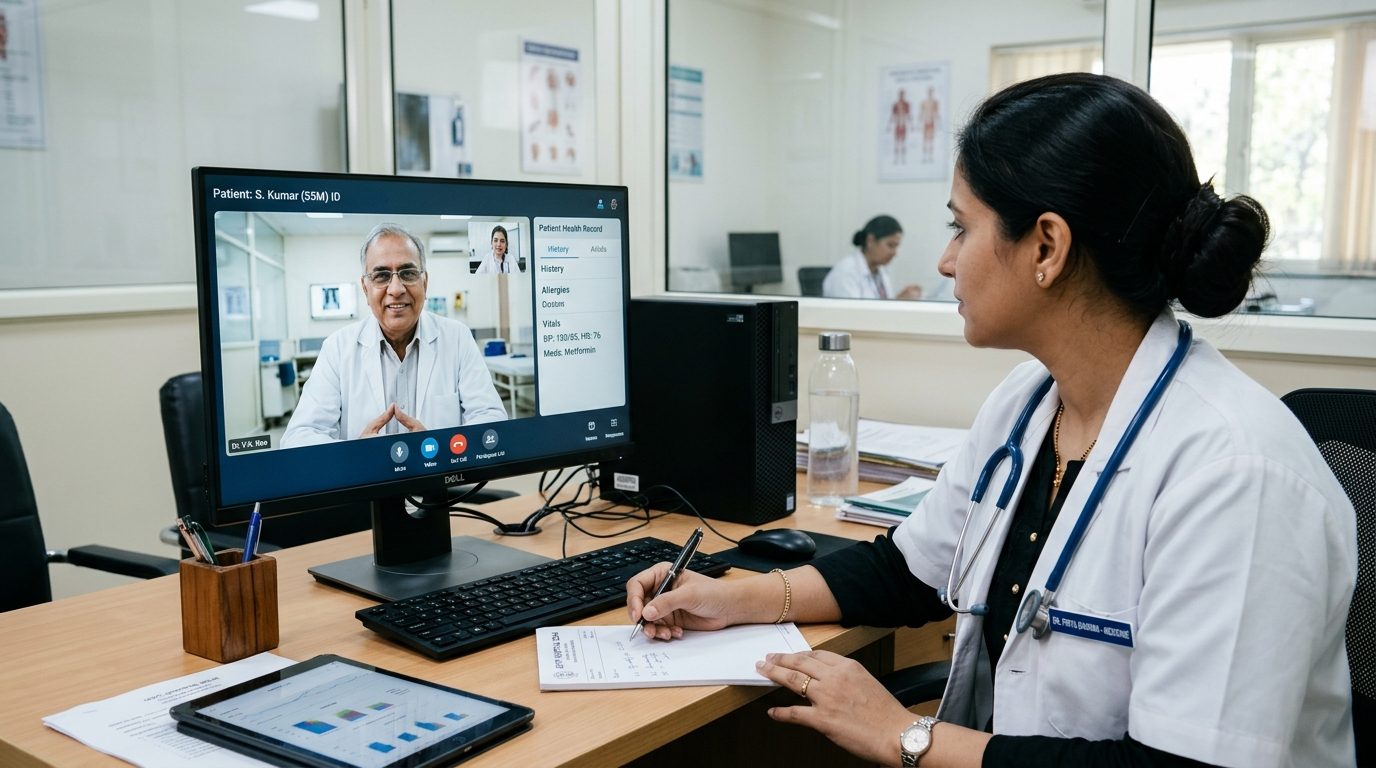
EGFR / ALK / PD-L1), (Bottom-Left) Longitudinal TNM Staging & Chemo/Radiation Timeline, and (Bottom-Right) Multi-Specialist Video Feed & Consensus Treatment Plan Sign-Off.Powering Cross-Border and Domestic Super-Specialty Second Opinions
The same infrastructure that powers internal tele-radiology and tumour boards also serves as a high-margin cross-border medical second opinion platform for domestic referrals and international “Heal in India” patients. Patients and referring physicians anywhere in India—or across Africa, the Middle East, and South/Southeast Asia—can securely upload complete DICOM imaging folders and clinical PDFs through a browser-based upload portal without installing software.
Once uploaded, the platform’s intake engine validates the DICOM series, creates a temporary pseudonymous consultation chart, collects online multi-currency or UPI consultation fees, and assigns the case to the appropriate super-specialist—delivering an authoritative, HPR-signed second opinion report and treatment pathway within 24 to 48 hours.

Democratizing Super-Specialty Excellence with OneHealthGrid
Distance should never determine whether a patient receives an accurate radiological diagnosis or an evidence-based oncology treatment plan. OneHealthGrid unifies RIS/PACS DICOMweb streaming, SLA-governed tele-radiology worklists, Virtual Tumour Board collaboration, and ABDM-compliant EHR workflows into a single enterprise platform—helping Indian health systems deliver world-class super-specialty care everywhere.
Accelerate Your Healthcare Digital Transformation with OneHealthGrid
Looking to implement enterprise-grade interoperability, clinical intelligence, and national digital health compliance across your hospital network? Explore our OneHealthGrid Tele-Radiology, DICOMweb & Virtual Tumour Board Suite or schedule a personalized architecture consultation with our healthcare engineering specialists.
National Standards & Regulatory References: Ayushman Bharat Digital Mission (ABDM) • National Health Authority (NHA) • NRCeS HL7 FHIR R4 Implementation Guides