
India has become the global epicenter of Non-Communicable Diseases (NCDs)—home to over 100 million citizens living with diabetes, more than 220 million adults with hypertension, and a rapidly rising prevalence of coronary artery disease, heart failure, chronic kidney disease (CKD), and chronic obstructive pulmonary disease (COPD). At the same time, urban nuclear family structures—where working children often live in different cities or countries while aging parents reside in Indian metros or Tier-2 towns—have created an urgent demand for structured, hospital-backed clinical oversight at home.
Traditionally, once an inpatient is discharged after coronary artery bypass grafting (CABG), heart failure stabilization, joint replacement, or a diabetic ketoacidosis episode, the hospital’s visibility into the patient’s recovery drops to zero until their scheduled outpatient review 10 to 14 days later. During this “post-discharge blind spot,” medication non-adherence, silent fluid overload, surgical wound infections, or glycemic swings frequently escalate into preventable emergency room readmissions. Remote patient monitoring in India closes this gap—extending the hospital’s clinical safety net directly into the patient’s living room through connected Internet of Medical Things (IoMT) devices and structured nursing command centers.
Why the Post-Discharge Window and Chronic NCD Management Demand Continuous Telemetry
In Indian tertiary care hospitals, reducing unplanned 30-day readmissions and retaining lifelong chronic disease cohorts are both clinical quality imperatives (tracked under NABH standards) and powerful revenue diversifiers. Episodic outpatient visits every three months capture only a single snapshot of a patient’s physiology:
- White-Coat vs. Masked Hypertension: A single blood pressure reading in a crowded OPD clinic misses nocturnal blood pressure surges and early-morning hypotensive dips caused by antihypertensive titration.
- Congestive Heart Failure (CHF) Decompensation: In heart failure patients, subtle daily weight gain of 1.5 to 2.0 kilograms over 72 hours—accompanied by a creeping resting heart rate and mild drop in SpO2—signals fluid retention days before acute pulmonary edema forces an emergency ICU admission.
- Gestational Diabetes and High-Risk Pregnancy Monitoring: Expectant mothers diagnosed with gestational diabetes mellitus (GDM) or pregnancy-induced hypertension require structured fasting and post-prandial capillary blood glucose and BP tracking between antenatal clinic visits.
Engineering IoMT Medical Device Integration Using HL7 FHIR R4 Observation Resources
A scalable remote patient monitoring in India program cannot rely on patients manually typing numbers into WhatsApp messages or unstructured spreadsheets. Equally, hospital doctors will never log into five separate consumer device portals (one for a glucometer brand, another for a smart scale, and a third for a holter ECG patch).
To unify home telemetry directly inside the hospital’s longitudinal Electronic Health Record (EHR), the platform must implement standardized IoMT medical device integration FHIR Observation pipelines:
- Cellular and Bluetooth Low Energy (BLE) Home Kits: Patients enrolled in a post-discharge cardiac and diabetes care India pathway receive a pre-paired cellular or BLE-connected diagnostic kit—such as an automated oscillometric blood pressure monitor, cellular glucometer, digital pulse oximeter, Bluetooth weighing scale, or single-/multi-lead wearable ECG patch.
- IEEE 11073 and LOINC Semantic Normalization: As soon as the patient takes a reading, the patient’s mobile PHR app or cellular hub transmits the encrypted payload to the hospital’s ingestion gateway. Each reading is normalized into an HL7 FHIR R4
Observationresource bound to its exact LOINC code (85354-9for Blood Pressure Panel,2339-0for Capillary Blood Glucose,59408-5for Oxygen Saturation by Pulse Oximetry,29463-7for Body Weight) and tagged withdeviceprovenance metadata distinguishing home IoMT readings from in-hospital clinical measurements. - ABHA Health Locker Synchronization: With the patient’s standing consent, summarized weekly telemetry trends are linked to their ABHA longitudinal health record while real-time streams feed the hospital’s clinical command center.

Designing the 3-Tier Wearable Vitals Alert Triage Command Center
The biggest operational mistake hospitals make when launching RPM is routing raw home device alerts directly to busy senior consultants’ mobile phones. A senior cardiologist in the middle of a cath-lab procedure cannot field 200 raw glucometer or blood pressure pings a day.
Successful home healthcare digital clinical pathways interpose a 3-Tier Clinical Triage Command Center between raw IoMT telemetry and the treating specialist:
Tier 1: Automated Algorithmic Filtering & Rolling Baseline Engine
The software evaluates incoming readings against personalized, physician-configured thresholds (e.g., Systolic BP > 160 mmHg or < 95 mmHg, Fasting Glucose < 70 mg/dL or > 220 mg/dL, Weight gain > 1.5 kg in 3 days). If a single borderline reading arrives, the patient’s app automatically prompts them to rest for 10 minutes and re-measure—filtering out 70% of motion-artifact or post-exertion false alarms.
Tier 2: Command Center Protocol Nurses (First-Line Human Filter)
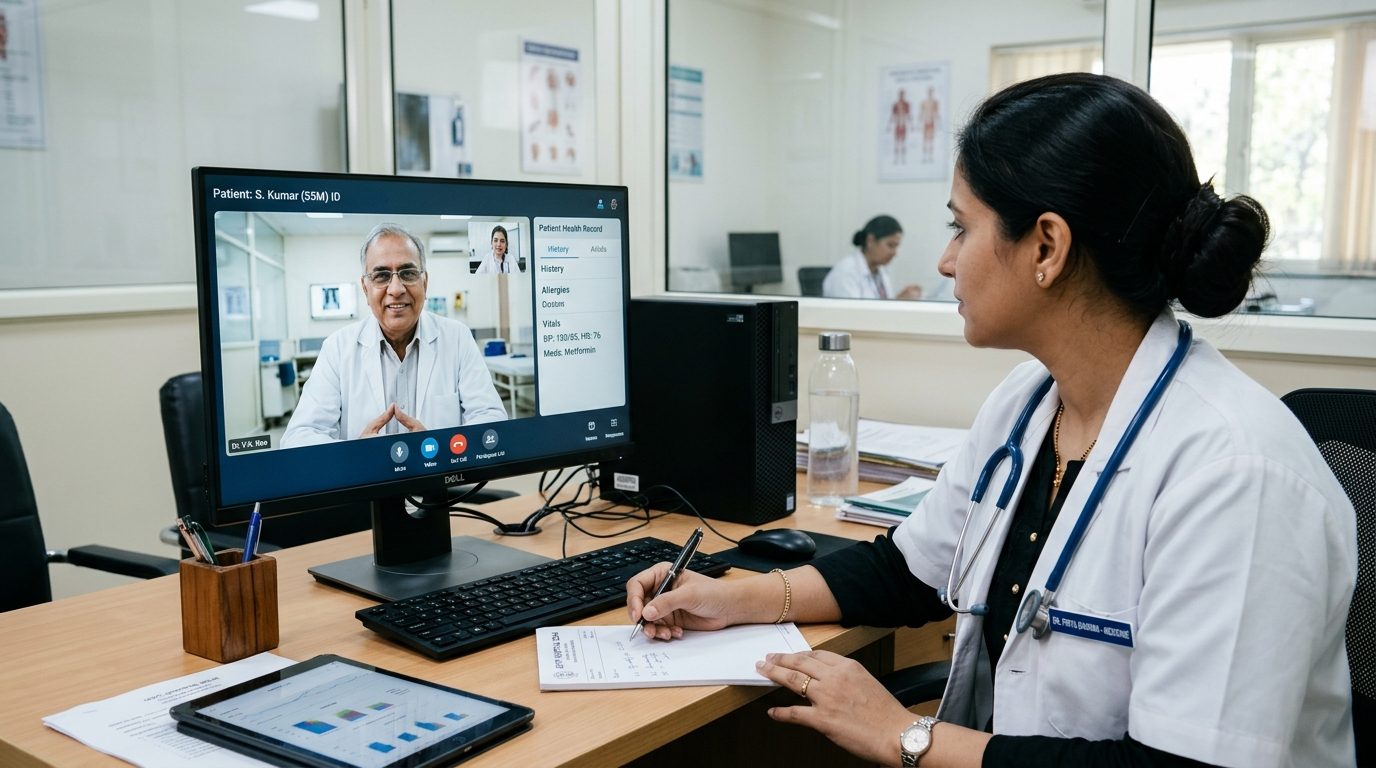
Validated amber/red alerts appear on the wearable vitals alert triage command center dashboard staffed by trained tele-monitoring nurses. The command-center nurse calls the patient or caregiver within 15 minutes to verify symptoms, check medication compliance (e.g., "Did you take your morning Amlodipine or Furosemide tablet?"), and complete a structured clinical triage checklist in the EHR.
Tier 3: Escalation to Treating Specialist or Rapid Home-Care / ER Dispatch
Only verified symptomatic or persistent physiological deviations are escalated to the treating consultant with a concise 30-second clinical summary and a 7-day trend sparkline—allowing the doctor to authorize a 1-click e-prescription dose adjustment, dispatch a home-healthcare phlebotomist/nurse visit, or fast-track an emergency hospital admission.

Red: Immediate Call Required, Amber: 2-Day Upward Trend, Green: Stable & Adherent), with a live 14-day BP/Glucose/Weight sparkline and a 1-click "Initiate Tele-Triage Call & Escalate to Consultant" action bar.Launching Profitable Subscription Care Programs with OneHealthGrid
With OneHealthGrid, Indian hospitals can package post-surgical recovery bundles, senior-citizen cardiac/diabetes care subscriptions, and high-risk maternity monitoring programs seamlessly inside their core HIS and EHR—driving recurring non-bed revenue while delivering compassionate, continuous care at home.
Accelerate Your Healthcare Digital Transformation with OneHealthGrid
Looking to implement enterprise-grade interoperability, clinical intelligence, and national digital health compliance across your hospital network? Explore our OneHealthGrid Remote Patient Monitoring (RPM) & Continuum Care or schedule a personalized architecture consultation with our healthcare engineering specialists.
National Standards & Regulatory References: Ayushman Bharat Digital Mission (ABDM) • National Health Authority (NHA) • NRCeS HL7 FHIR R4 Implementation Guides